
Home » SPLASH™ eMTBR-tau243 & BD pTau-217 Kit
SPLASH™ eMTBR-tau243 & BD pTau-217 Kit
Ultrasensitive eMTBR-tau243 and BD pTau-217 quantification on a standard qPCR instrument
Measure eMTBR-tau243 and BD pTau-217 in human EDTA plasma and cerebrospinal fluid (CSF) with a benchtop proximity ligation assay. The SPLASH™ eMTBR-tau243 & BD pTau-217 Duplex Kit gives your laboratory a focused assay panel for academic and biopharma research using compatible qPCR instrumentation.
- Catalogue
- TSK-00011
- Size
- 96 reactions
- Price
- US$1,999.00
For Research Use Only. Not for use in diagnostic procedures.
Peer-reviewed research using SPLASH
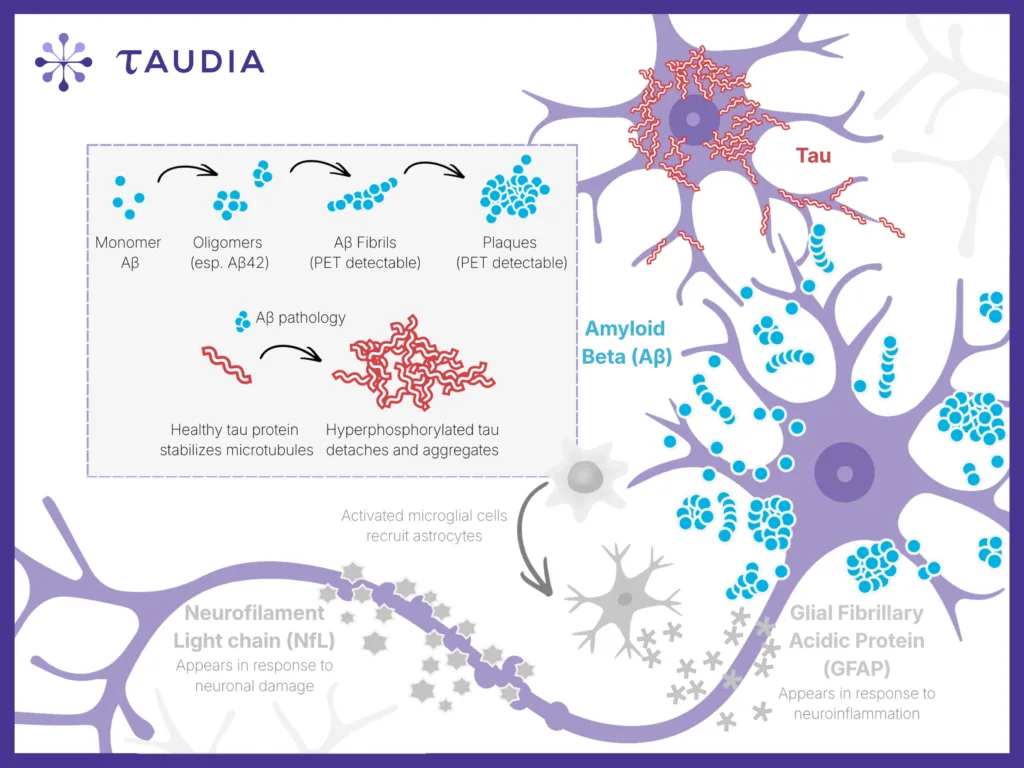
Explore the research supporting SPLASH in Scientific Reports, coauthored by Taudia scientific advisor Jennifer S. Yokoyama and colleagues. The study describes benchtop qPCR measurement of Alzheimer’s disease-associated plasma biomarkers, including discrimination of amyloid PET status by SPLASH pTau-217 in 101 participants and application of the five-analyte panel (pTau-217, Aβ40, Aβ42, NfL, and GFAP) to a separate set of 69 plasma samples. You can review its experimental methods and research findings when planning your study. 1
eMTBR-tau243 and BD pTau-217 in Alzheimer’s disease research
Alzheimer’s disease involves multiple biological processes, including amyloid-beta accumulation and tau pathology. BD pTau-217 (brain-derived pTau-217) is designed to measure the brain-derived form of tau phosphorylated at threonine 217, distinguishing it from conventional pTau-217 measurements that may include tau originating outside the central nervous system. eMTBR-tau243 is a biomarker associated with tau tangle pathology. Together, these biomarkers offer researchers a way to investigate complementary aspects of Alzheimer’s disease biology. 2 to 4
BD pTau-217 is associated with Alzheimer’s disease pathology related to amyloid-beta, while eMTBR-tau243 has shown associations with tau PET burden and cognitive impairment. Research combining these biomarkers suggests they may help characterize both the presence of Alzheimer’s disease pathology and the burden of aggregated tau. 2 to 4
Plasma enables minimally invasive collection, repeat sampling, and studies using archived specimens. Researchers can examine BD pTau-217 and eMTBR-tau243 alongside amyloid PET, which assesses fibrillar amyloid deposition, and tau PET, which characterizes aggregated tau pathology. 3, 4
Assay performance
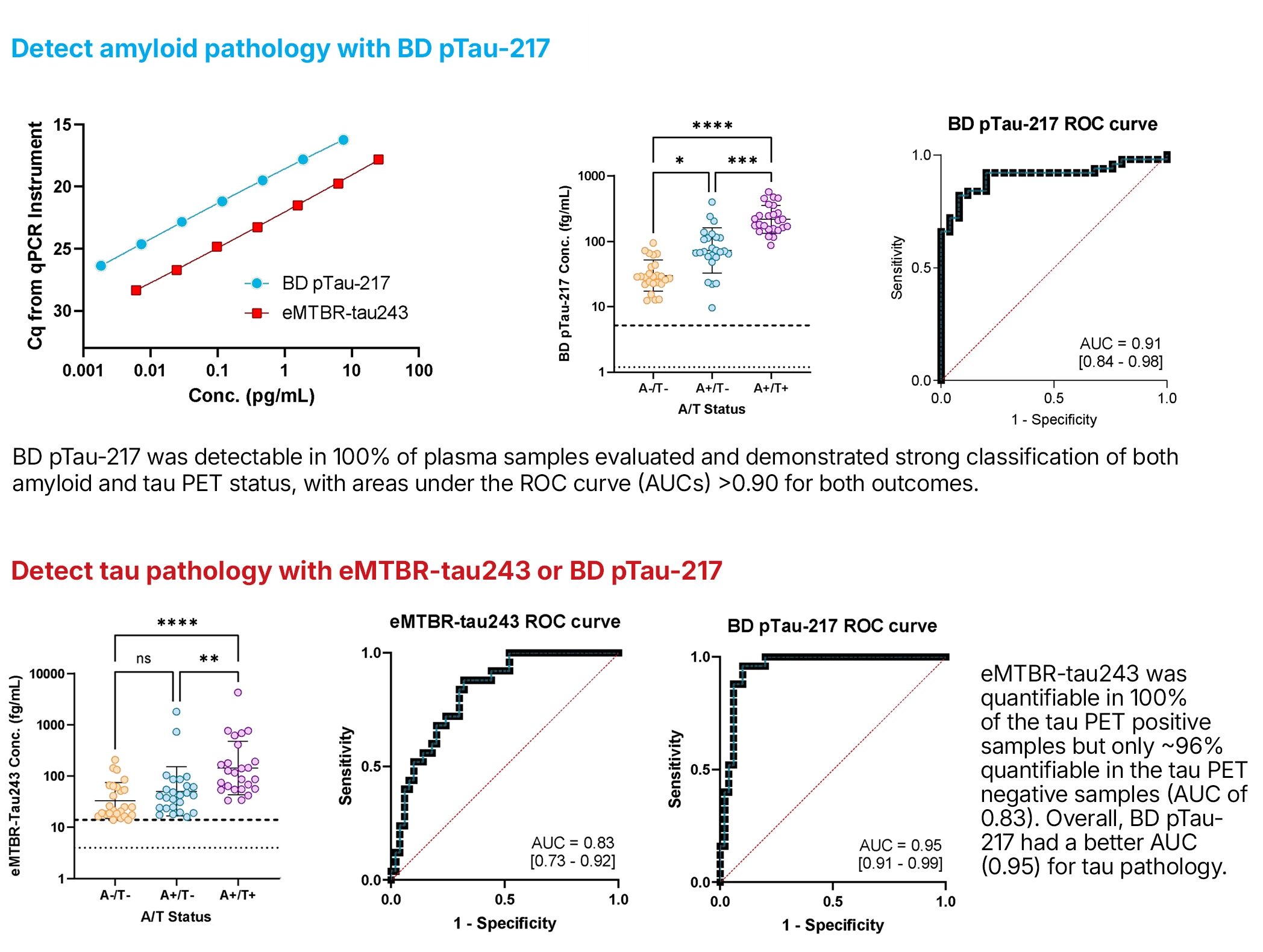
BD pTau-217 and eMTBR-tau243 were quantified in human plasmas using SPLASH™ eMTBR-tau243 & BD pTau-217 Kit. Plasma samples were obtained from the Bio-Hermes-002 cohort and annotated according to amyloid and tau PET status. To focus on the AD continuum, the initial plasma analyses included the A−/T−, A+/T−, and A+/T+ groups (n = 25 for each group). Biomarker detectability and receiver operating characteristic (ROC) analyses were used to assess classification of amyloid and tau PET status.
BD pTau-217 was detectable in 100% of plasma samples evaluated and demonstrated strong classification of both amyloid and tau PET status, with areas under the ROC curve (AUCs) >0.90 for both outcomes. eMTBR-tau243 was quantifiable in 100% of the tau PET positive samples but only ~96% quantifiable in the tau PET negative samples (AUC of 0.83).
An important consideration is that this cohort consisted primarily of individuals with mild-to-moderate AD, potentially limiting representation of advanced tau pathology. The relatively modest performance of eMTBR-tau243 compared with BD pTau-217 may therefore reflect the stage dependence of this biomarker. eMTBR-tau243 may become more informative as tau pathology becomes more advanced, consistent with its potential utility for later-stage disease.
How SPLASH measures eMTBR-tau243 & BD pTau-217 in the same reaction
SPLASH™ stands for Solid Phase Ligation Assay with Single wasH. Antibody-linked DNA probes recognize each target, and proximity ligation generates an amplifiable DNA signal. Magnetic bead capture and washing remove unbound probes before the ligation and qPCR program. Explore the SPLASH technology and immuno-PCR workflow for the assay principle.
- 1SetupSample and standard preparation
- 2BindingOvernight at 4 °C, recommended
- 3Wash15 minutes
- 4Ligation and qPCRAbout 1 hour
- 5AnalysisCq values into TallyPro
Your benchtop workflow comprises sample and standard preparation. Since eMTBR-tau243 is a very low-abundance protein, we recommend an overnight binding incubation at 4 °C, a 15-minute wash step, and an approximately 1-hour ligation and qPCR program.
Export Cq values from your instrument and use TallyPro analysis software with the assay template to calculate concentrations in pg/mL. You will need compatible plates, a magnetic rack, calibrated pipettes, and the consumables listed in the SPLASH Duplex User Guide.
Choose the assay format for your study
Use the eMTBR-tau243 & BD pTau-217 when these targets are your primary analyte or an addition to an existing research panel. Browse the SPLASH biomarker kits catalogue to compare available formats. BD pTau-217 is also available in a singleplex format.
For an analyte outside the catalogue, explore the STEP custom assay development program to discuss developing, validating, and deploying an assay with your team. For this kit, contact Taudia about your study to discuss sample planning and instrument setup.
Inquire about this kitFrequently asked questions
What is the eMTBR-tau243 & BD pTau-217 duplex?
Alzheimer’s disease involves multiple biological processes, including amyloid-related changes and tau pathology. The SPLASH™ eMTBR-tau243 & BD pTau-217 Duplex kit measures two complementary biomarkers: eMTBR-tau243, associated with tau tangle pathology, and brain-derived pTau-217 (BD pTau-217), which is studied in relation to Alzheimer’s disease pathology. Together, they allow researchers to investigate complementary aspects of tau biology and Alzheimer’s disease progression. [2 to 4]
How much plasma does the eMTBR-tau243 & BD pTau-217 duplex assay need?
The assay uses 12.5 µL of EDTA plasma per reaction at 4× dilution. Allow additional specimen volume for replicates and pipetting losses.
Can I measure the eMTBR-tau243 & BD pTau-217 duplex in CSF?
Yes, CSF measurement uses 5 µL per reaction at 10× dilution. Use the CSF preparation conditions when planning your experiment.
Which qPCR instruments are supported?
The duplex kit is designed for 96-well qPCR instruments with at least 2 optical channels (FAM/HEX or FAM/VIC) and compatible 0.2 mL plates. Downloadable templates cover Opus96 and QuantStudio 1, 3, 5, 6 Flex, 6 Pro, 7 Flex, and 7 Pro configurations. Check your model and plate format against the eMTBR-tau243 & BD pTau-217 duplex templates.
What are the detection and quantification limits?
For BD pTau-217, all plasma samples were quantifiable. For eMTBR-tau243, 100% of Tau PET positive samples were quantifiable.
How many samples can I run with one kit?
Each kit supplies 96 reactions across up to two runs, including wells used for standards, blanks, controls, and replicates. Your study sample capacity therefore depends on the plate layout.
Can I combine the eMTBR-tau243 & BD pTau-217 duplex results from different assays?
Results from different assays require a bridging assessment before you combine them quantitatively. Antibody recognition, calibrators, and matrix effects can influence concentration values, so a shared pg/mL unit does not establish agreement.
References and assay documents
Reference 1 describes SPLASH research; references 2 to 4 provide independent biological context. The kit is for research use only.
- Elder N et al. SPLASH: a benchtop platform for accessible, ultrasensitive quantification of plasma biomarkers in Alzheimer’s disease. Scientific Reports (2026), Article in Press.
- Ashton NJ et al. JAMA Neurology, 2024. DOI 10.1001/jamaneurol.2023.5319.
- Horie K et al. Nature Medicine, 2025. DOI 10.1038/s41591-025-03617-7.
- Mattsson-Carlgren N et al. The Lancet Neurology, 2026. DOI 10.1016/S1474-4422(26)00029-3.
Documentation
Looking for something else or need help finding the right file? Reach out to us at hello@taudia.com.