
Home » SPLASH™ pTau-217 Singleplex Kit
SPLASH™ pTau-217 Singleplex Kit
Ultrasensitive pTau-217 quantification on a standard qPCR instrument
Measure pTau-217 in human EDTA plasma and cerebrospinal fluid (CSF) with a benchtop proximity ligation assay. The SPLASH™ pTau-217 Singleplex Kit gives your laboratory a focused assay for academic and biopharma research using compatible qPCR instrumentation.
- Catalogue
- TSK-00001
- Size
- 96 reactions
- Price
- US$1,199
For Research Use Only. Not for use in diagnostic procedures.
Peer-reviewed research using SPLASH
Explore the research supporting SPLASH in Scientific Reports, coauthored by Taudia scientific advisor Jennifer S. Yokoyama and colleagues. The study describes benchtop qPCR measurement of Alzheimer’s disease-associated plasma biomarkers and examines SPLASH pTau-217 measurements in 101 participants characterized by amyloid PET. You can review its experimental methods and research findings when planning your study. 1
High quality data with the easiest ultrasensitive workflow.
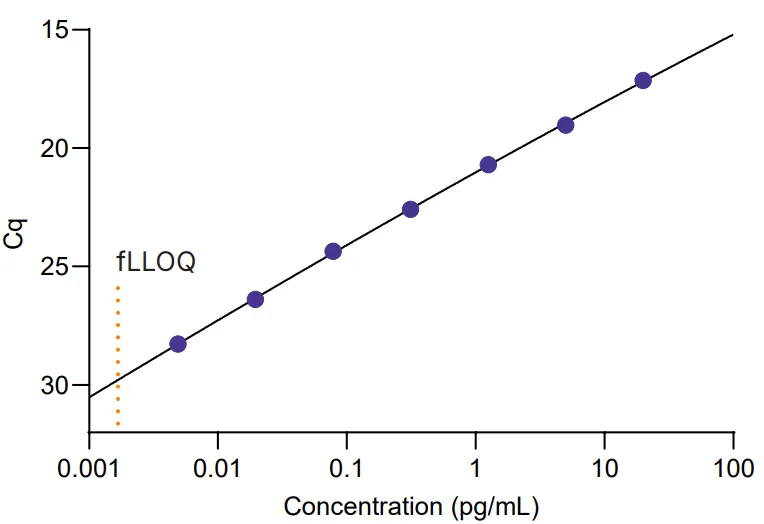
Wide dynamic range to quantify your samples
Best-in-class analytical performance with a workflow easier than ELISA
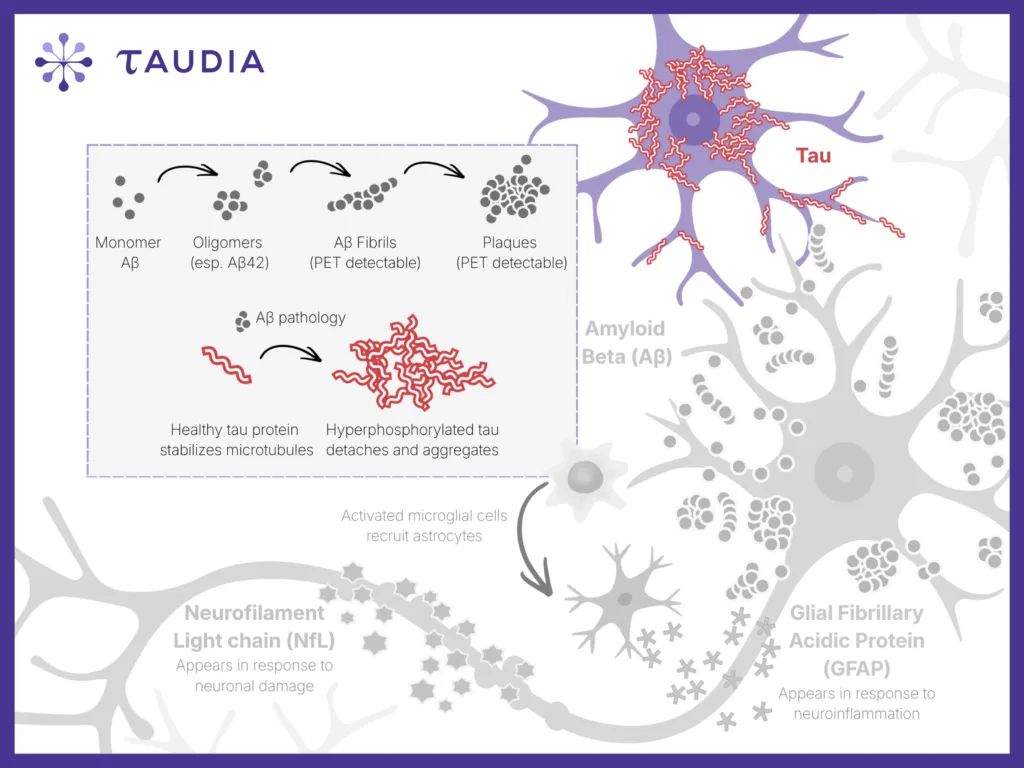
pTau-217 biology in Alzheimer’s disease research
pTau-217 is tau protein phosphorylated at threonine 217, a soluble biomarker studied in blood and CSF for its association with Alzheimer’s disease pathology. You may also encounter the spelling p-tau217 in the literature. Measuring it lets you investigate soluble tau phosphorylation alongside other biological changes in your research cohort. 2, 3, 4
Plasma supports repeated blood collection and studies using archived specimens. CSF provides a complementary fluid compartment for central nervous system biomarker research, although collection requires lumbar puncture. Your choice depends on the study question and available samples. Concentrations, preparation conditions, and analytical limits differ between matrices, so interpret plasma and CSF as distinct measurements.
You can examine plasma pTau-217 alongside amyloid PET, which assesses fibrillar amyloid deposition, and tau PET, which characterizes the regional distribution of aggregated tau. Published studies also evaluate relationships with CSF pTau-217, other phosphorylated tau measures, and the CSF Aβ42/Aβ40 ratio. These studies examine relationships between soluble pTau-217 and fluid or imaging measures of amyloid and tau pathology. 2, 4
For longitudinal studies, independent research links plasma pTau-217 to subsequent cognitive change and changes in amyloid and tau imaging measures. These studies examined biomarker associations with disease trajectories in their research cohorts. 3, 4
Analytical performance
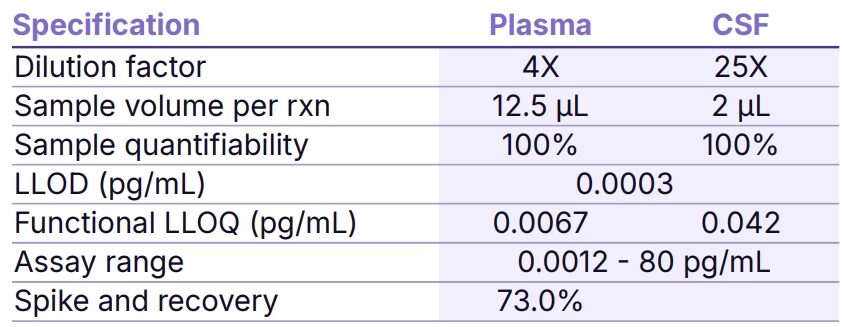
Use the following results to review the assay’s documented performance in the tested samples and conditions. All analytical figures in this section come from Taudia Data Sheet TDS-00001 for TSK-00001. The calibration curve uses four-parameter logistic regression (4PL).
| Specification | Reported value |
|---|---|
| Plasma input and dilution | 12.5 µL per reaction; 4× |
| CSF input and dilution | 2 µL per reaction; 25× |
| Analytical LLOD in sample buffer | 0.0003 pg/mL |
| Functional LLOQ in plasma | 0.0067 pg/mL |
| Functional LLOQ in CSF | 0.042 pg/mL |
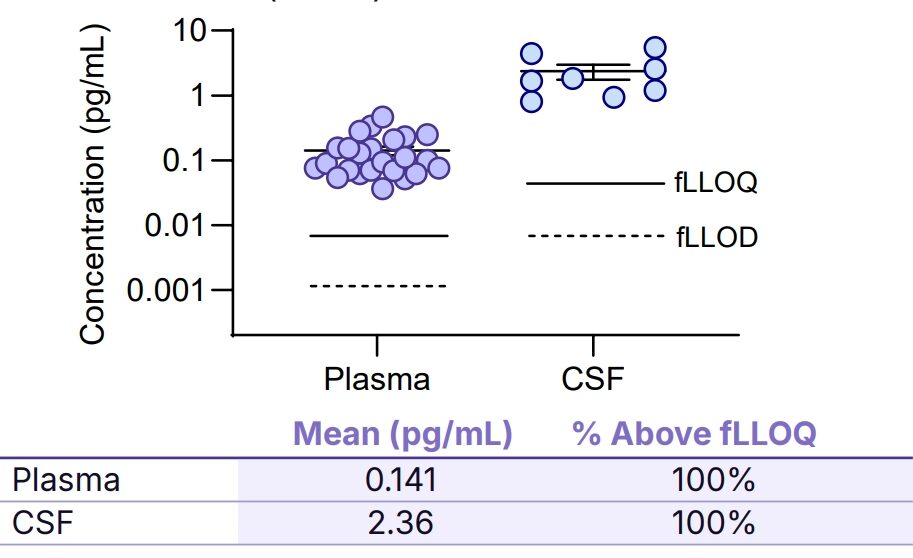
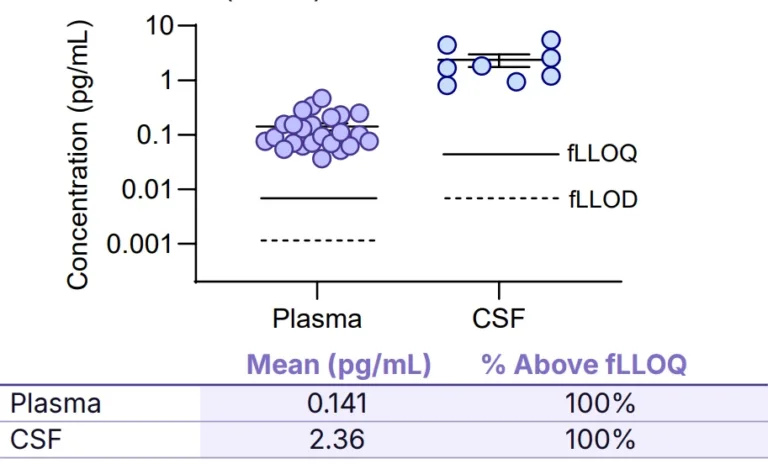
For endogenous sample testing, Taudia measured specimens from apparently healthy donors aged 55 years and older in triplicate. The table reports mean concentrations and the percentage of specimens above fLLOQ for that donor set. [TDS-00001]
| Matrix | Donors | Mean concentration | Above fLLOQ |
|---|---|---|---|
| EDTA plasma | n = 24 | 0.141 pg/mL | 100% |
| CSF | n = 8 | 2.36 pg/mL | 100% |
Dilution linearity was assessed in two apparently healthy donor EDTA plasma samples diluted from 4× to 32×. Recovery expresses the measured concentration relative to the expected concentration; parentheses retain the ranges reported in the data sheet. [TDS-00001]
| Dilution | Recovery with reported range |
|---|---|
| 4× | 79.3% (74.2 to 86.6%) |
| 8× | 100.8% (93.0 to 105.4%) |
| 16× | 108.7% (99.0 to 115.5%) |
| 32× | 111.5% (99.0 to 132.0%) |
Recovery and sensitivity methods
Spike recovery
73.0%
Mean spike recovery was 73.0% across two EDTA plasma samples, each spiked at low and high concentrations within the assay range. Recovery was calculated from the increase over the unspiked sample relative to the spike concentration in sample buffer.
LLOD
0.0003 pg/mL
For LLOD, Taudia read 15 sample-buffer replicates against the calibration curve in each of six runs. The per-run threshold was the mean background plus 2.5 standard deviations; the reported LLOD was the median across runs.
LLOQ
0.0067 pg/mL plasma
For LLOQ, six replicates of serially diluted standard material were evaluated across six runs. The lowest concentration returning 80 to 120% of its expected value with a CV below 20% defined each run’s LLOQ. Taudia reported the median across runs and multiplied it by the sample dilution factor to obtain fLLOQ.
How SPLASH measures pTau-217
SPLASH™ stands for Solid Phase Ligation Assay with Single wasH. Antibody-linked DNA probes recognize pTau-217, and proximity ligation generates an amplifiable DNA signal. Magnetic bead capture and washing remove unbound probes before the ligation and qPCR program. Explore the SPLASH technology and immuno-PCR workflow for the assay principle.
- 1Setup15 minutes
- 2Binding2 hours at room temperature, or overnight at 4 °C
- 3Wash15 minutes
- 4Ligation and qPCRAbout 1 hour
- 5AnalysisCq values into TallyPro
Your benchtop workflow comprises sample and standard preparation, a 2-hour room-temperature binding incubation, a wash stage, and an approximately 1-hour ligation and qPCR program. The quick guide allocates 15 minutes to setup and 15 minutes to washing, giving approximately 3.5 hours before analysis; overnight binding at 4 °C is an alternative.
Export Cq values from your instrument and use TallyPro analysis software with the assay template to calculate concentrations in pg/mL. You will need compatible plates, a magnetic rack, calibrated pipettes, and the consumables listed in the SPLASH Singleplex User Guide.
Choose the assay format for your study
Use the singleplex when pTau-217 is your primary analyte or an addition to an existing research panel. Browse the SPLASH biomarker kits catalogue to compare available formats. The pTau-217 and Aβ42 Duplex Kit supports paired measurements, while the AD 5-plex panel includes pTau-217, Aβ42, Aβ40, NfL, and GFAP for broader biomarker profiling.
For an analyte outside the catalogue, explore the STEP custom assay development program to discuss developing, validating, and deploying an assay with your team. For this kit, inquire about your study to discuss sample planning and instrument setup.
Inquire about this kitFrequently asked questions
What is pTau-217?
pTau-217 is tau phosphorylated at threonine 217, studied as a soluble biomarker associated with Alzheimer’s disease pathology. In research, you can examine it alongside amyloid PET, tau PET, and CSF biomarkers. [2, 3, 4]
How much plasma does the pTau-217 assay need?
The assay uses 12.5 µL of EDTA plasma per reaction at 4× dilution. Allow additional specimen volume for replicates and pipetting losses.
Can I measure pTau-217 in CSF?
Yes, TDS-00001 characterizes CSF measurement using 2 µL per reaction at 25× dilution, with an fLLOQ of 0.042 pg/mL. Use the CSF preparation conditions when planning your experiment.
Which qPCR instruments are supported?
The kit is designed for 96-well qPCR instruments with FAM detection and compatible 0.2 mL plates. Downloadable templates cover Opus96 and QuantStudio 1, 3, 5, 6 Flex, 6 Pro, 7 Flex, and 7 Pro configurations. Check your model and plate format against the pTau-217 instrument templates.
What are the detection and quantification limits?
The analytical LLOD is 0.0003 pg/mL in sample buffer, and the plasma fLLOQ is 0.0067 pg/mL at 4× dilution. Detection and quantification describe different analytical thresholds; use fLLOQ when interpreting low-concentration quantitative results.
How many samples can I run with one kit?
Each kit supplies 96 reactions across up to two runs, including wells used for standards, blanks, controls, and replicates. Your study sample capacity therefore depends on the plate layout.
Can I combine pTau-217 results from different assays?
Results from different assays require a bridging assessment before you combine them quantitatively. Antibody recognition, calibrators, and matrix effects can influence concentration values, so a shared pg/mL unit does not establish agreement.
References and assay documents
Reference 1 describes SPLASH research; references 2 to 4 provide independent biological context. The kit is for research use only.
- Elder et al. SPLASH: a benchtop platform for accessible, ultrasensitive quantification of plasma biomarkers in Alzheimer’s disease. Scientific Reports (2026), Article in Press.
- Ashton NJ et al. JAMA Neurology, 2024. DOI 10.1001/jamaneurol.2023.5319.
- Ossenkoppele R et al. Nature Aging, 2025. DOI 10.1038/s43587-025-00835-z.
- Lan G et al. Nature Aging, 2025. DOI 10.1038/s43587-025-00904-3.
Documentation
Quant Studio Run Files
- Taudia_QS1_Singleplex_pTau-217-V1.edt
- Taudia_QS3_0.2mL_Singleplex_pTau-217-V1.edt
- Taudia_QS5_0.2mL_Singleplex_pTau-217-V1.edt
- Taudia_QS6Flex_0.2mL_Singleplex_pTau-217-V1.edt
- Taudia_QS6Pro_0.2mL_Singleplex_pTau-217-V1.edt
- Taudia_QS7Flex_0.2mL_Singleplex_pTau-217-V1.edt
- Taudia_QS7Pro_0.2mL_Singleplex_pTau-217-V1.edt
Looking for something else or need help finding the right file? Reach out to us at hello@taudia.com.